

Most businesses invest in design before they invest in strategy and it shows.
The result? A brand that looks polished on the surface but lacks the clarity and consistency needed to actually connect with the right audience, earn trust, and drive growth.
What You’ll Learn
Brand strategy and positioning define how your business is perceived and why customers choose you over competitors.
- What brand strategy and positioning actually mean
- Why they matter for growth
- The key components of a strong brand
- How to evaluate your current strategy
This guide covers everything you need to know about brand strategy and positioning: what it is, why it matters, how to build it, and how to know if it is working. Whether you are starting from scratch or refining an existing brand, these principles will help you build something that lasts.
What Is Brand Strategy?
Brand strategy is the blueprint for your brand. It defines who you are, who you serve, what makes you different, how you communicate, and how you want to be perceived in the market.
It is not just a mission statement or a tagline. Brand strategy is the foundational layer that informs every decision your business makes, from website copy and social media to sales conversations and customer experience.
A well-built brand strategy does not expire. It evolves over time while staying rooted in clarity and purpose.
Think of brand strategy as the difference between a business that reacts to trends and one that leads with intention. Brands with a strong strategic foundation do not scramble to reinvent themselves every year—they grow from a place of consistency and conviction.
What Is Brand Positioning?
Brand positioning is how your audience perceives you in relation to your competitors. It answers one critical question:
Why should someone choose you instead of someone else?
Strong positioning is clear, specific, and differentiated. It is not trying to appeal to everyone. It does not rely on vague, generic language. And it does not disappear when placed next to competitors.
When your positioning is weak, your brand blends in. When it is strong, your brand becomes the obvious choice for the right audience.
Why Brand Strategy and Positioning Matter More Than Ever
In 2026, brands are competing in an AI-driven, content-saturated marketplace. More content is being created than ever before. Attention spans are shorter. And differentiation is harder to achieve through tactics alone.
Without a clear strategy, your brand becomes noise. With one, it becomes a signal that cuts through.
Here is what strong brand strategy and positioning actually do for your business:
- Improve marketing performance by giving every campaign a clear foundation
- Build trust faster because audiences know exactly what you stand for
- Increase brand recognition across channels and touchpoints
- Attract higher-value clients who are aligned with your positioning
- Reduce wasted spend on messaging that does not resonate
Brand strategy and positioning is not a luxury for large companies. It is the foundation that makes everything else work—regardless of your size or industry.
Brand Strategy Framework: Core Elements Explained a Strong Brand Strategy
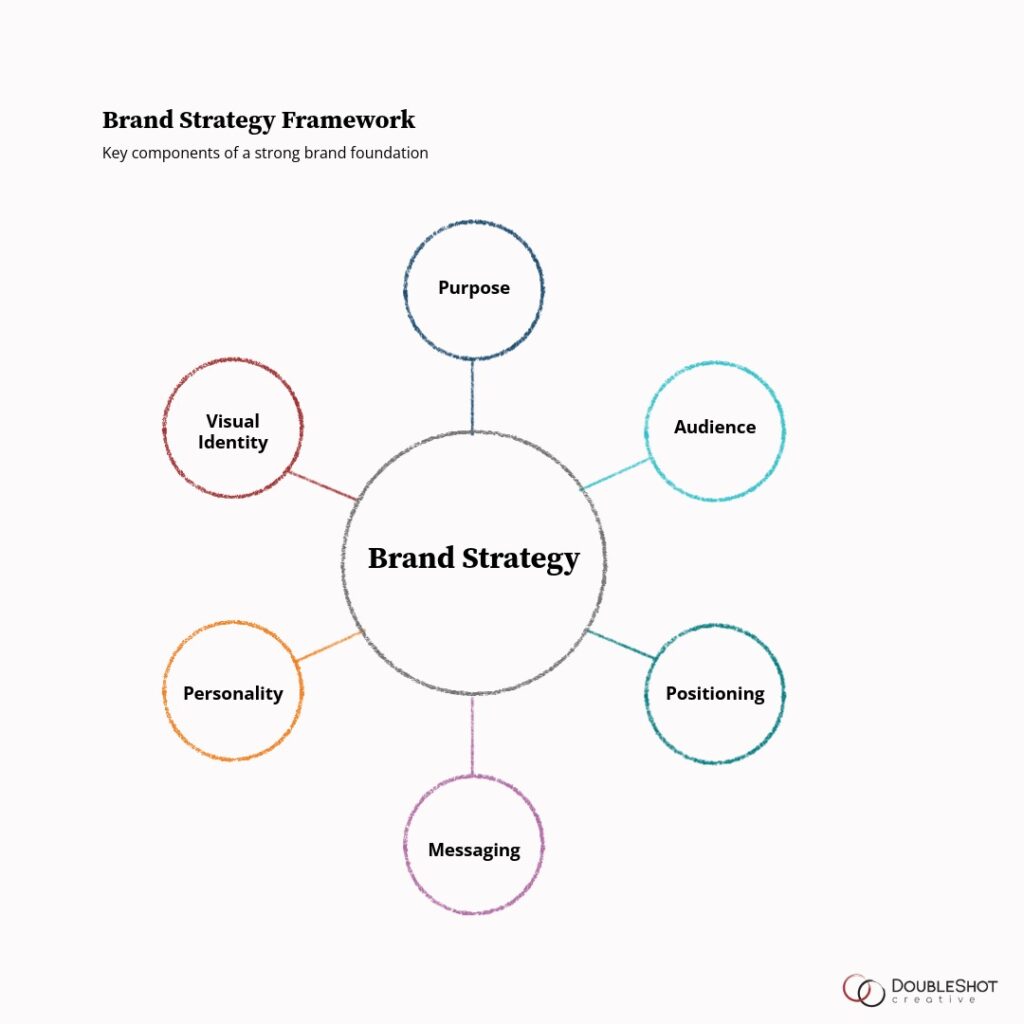
A complete brand strategy is built from several interconnected components. Each one plays a specific role in how your brand shows up in the world.
1. Brand Purpose and Vision
Your brand purpose is what you stand for beyond making money. It is the reason your business exists and the impact you are trying to have. Your vision defines where you are going.
Together, purpose and vision give your brand meaning. They give your audience a reason to care—and your team a clear direction to move toward. Without this, brands tend to drift.
2. Target Audience Clarity
If your brand is for everyone, it is for no one.
The most effective brands are built around a deep understanding of a specific audience: who they are, what they care about, what keeps them up at night, and what they are looking for.
This does not mean excluding people. It means being intentional about who you are speaking to so your message actually lands.
3. Brand Personality
Your brand should feel human, not corporate. Brand personality defines the tone, voice, and energy your brand brings to every interaction.
Are you bold and disruptive? Friendly and approachable? Premium and refined? Personality is what makes people connect with your brand emotionally, not just rationally.
If you need inspiration, take a look at some of the brand personalities we are crushing on to see how distinct tone and voice show up in real brands.
4. Brand Archetypes
One of the most effective frameworks for defining brand personality is archetypes—universal character types people instinctively recognize.
Whether you are the Hero, the Rebel, the Caregiver, or the Explorer, archetypes help align your tone, visuals, and messaging into something cohesive and memorable.
This is exactly why many brands lean into archetypes. In our breakdown of brand archetypes, we walk through how these universal character types help create clarity and emotional connection.
5. Brand Positioning Statement
Your positioning statement is an internal tool, not a tagline. It defines your audience, your category, your unique value, and the proof behind it.
For [target audience] who [specific need], [Brand Name] is the [category] that [unique differentiator] because [reason to believe].
This becomes your internal north star—guiding messaging, campaigns, and decisions across the business.
6. Messaging Framework
Your messaging framework ensures consistency across every channel and every team member.
Without it, your brand voice shifts depending on who is writing. With it, everything—from your homepage to your sales deck—feels aligned and intentional.
7. Visual Identity (Last, Not First)
Design matters, but it is not the starting point.
Your logo, colors, typography, and visual system should reflect your strategy, not replace it.
This is a common mistake we see often—focusing on visuals first instead of strategy. As we explain in Your Brand Is More Than a Logo, design alone cannot carry your brand without a strategic foundation.
Weak vs Strong Brand Positioning Examples
| Weak Positioning | Strong Positioning |
| We help businesses grow | We help B2B SaaS companies reduce churn through onboarding design |
| Appeals to everyone | Speaks directly to a defined audience |
| Generic and interchangeable | Clearly differentiated |
| Inconsistent messaging across channels | Consistent voice across channels |
| Audience unsure what you do | Audience instantly understands your value |
Common Branding Mistakes and How to Avoid Them
Even smart companies get branding wrong. Here are the patterns we see most often:
Jumping straight into design without strategy
- Trying to appeal to too many audiences
- Copying competitors instead of identifying what actually sets you apart
- Inconsistent messaging across platforms
- Treating brand as a one-time project
We break this down further in 5 Branding Mistakes Even Smart Companies Make, including how to correct these issues before they start impacting growth.
How to Know If Your Brand Strategy and Positioning Is Working
Brand strategy can feel abstract, but its impact shows up in very real ways.
Ask yourself:
✔︎ Do people understand what we do within seconds?
✔︎ Are we clearly different from competitors?
✔︎ Is messaging consistent across channels?
✔︎ Are we attracting the right audience?
✔︎ Can clients articulate our value in their own words?
If the answer is no to any of these, it is not a failure, it is an opportunity to strengthen your foundation.
Brand Strategy and Positioning is a Long-Term Growth Asset
Unlike trend-driven tactics, brand strategy compounds over time.
It becomes the foundation for everything else from SEO content and paid campaigns to sales conversations and referral growth.
When your brand is clear, your marketing gets easier. When your brand is consistent, trust builds faster. When your brand is differentiated, you stop competing on price.
Frequently Asked Questions About Brand Strategy and Positioning
What is the difference between brand strategy and brand identity?
Brand strategy is the thinking behind your brand: who you are, who you serve, and how you want to be perceived. Brand identity is the visual expression of that thinking: your logo, colors, typography, and design system. Strategy comes first. Identity should be built to reflect it.
How long does it take to develop a brand strategy?
A thorough brand strategy typically takes four to six weeks when done properly. This includes research, audience analysis, competitive positioning, and the development of your messaging framework. Shortcuts in this process tend to show up later as inconsistency and confusion.
Do small businesses need brand strategy and positioning?
Yes, especially small businesses. A clear brand strategy is one of the most efficient uses of a limited marketing budget. It ensures that every dollar spent on content, ads, or design is working toward the same goal and speaking to the right audience.
What is the difference between brand positioning and a value proposition?
Your value proposition describes the specific benefit your product or service delivers. Your brand positioning is broader. It defines how you want to be perceived relative to your competitors across every aspect of your brand, not just your product offering.
How often should you revisit your brand strategy?
Most brands benefit from a strategic review every two to three years, or whenever there is a significant change: entering a new market, launching a new product, shifting your audience, or responding to major competitive changes. Small updates happen continuously. A full repositioning is less frequent.
Ready to Build a Brand That Works?
A strong brand is not just seen. It is felt. The businesses that win in their markets are not always the biggest or the best-funded. They are the ones with the clearest, most consistent, most compelling story.
Brand strategy and positioning is how you build that story. And it starts with making deliberate choices about who you are, who you serve, and why it matters.
If you are ready to build a more cohesive and impactful brand, explore our brand identity and strategy services or get in touch to start the conversation.